In a traditional Florida personal injury case, the injured plaintiff carries the burden of proving exactly how the defendant acted negligently—whether by running a red light, spilling liquid on a supermarket floor, or speeding in a school zone. But what happens when an accident occurs under circumstances where the victim cannot possibly know what went wrong behind closed doors?
In Florida jurisprudence, the legal doctrine of "res ipsa loquitur" ("the thing speaks for itself") allows an inference of negligence when the very occurrence of the accident points to someone's carelessness. Recognized by the Florida Supreme Court in landmark cases such as McDougald v. Perry, this doctrine plays a pivotal role in complex premises, mechanical, and commercial injury claims.
The Florida legal framework: The elements of res ipsa loquitur
Under Florida law, res ipsa loquitur is an evidentiary rule rather than a standalone cause of action. In McDougald v. Perry, 716 So. 2d 783 (Fla. 1998), the Florida Supreme Court clarified that the doctrine permits—but does not compel—a jury to infer negligence when direct evidence is unavailable.
To establish the doctrine in Florida courts, an injured person must demonstrate three core elements:
1. The occurrence is of a kind that ordinarily does not happen in the absence of negligence.
2. The instrumentality causing the harm was under the defendant's exclusive management or control at the time the negligence occurred.
3. The accident was not due to any voluntary action or contribution on the part of the injured claimant.
Key Point
Res ipsa loquitur does not mean automatic victory. It simply gets your case past a defense motion for summary judgment and allows a jury to infer negligence even when direct eyewitness testimony is missing.
Common scenarios where res ipsa loquitur applies in Florida
While Florida courts apply the doctrine narrowly, common scenarios where res ipsa loquitur may be invoked include:
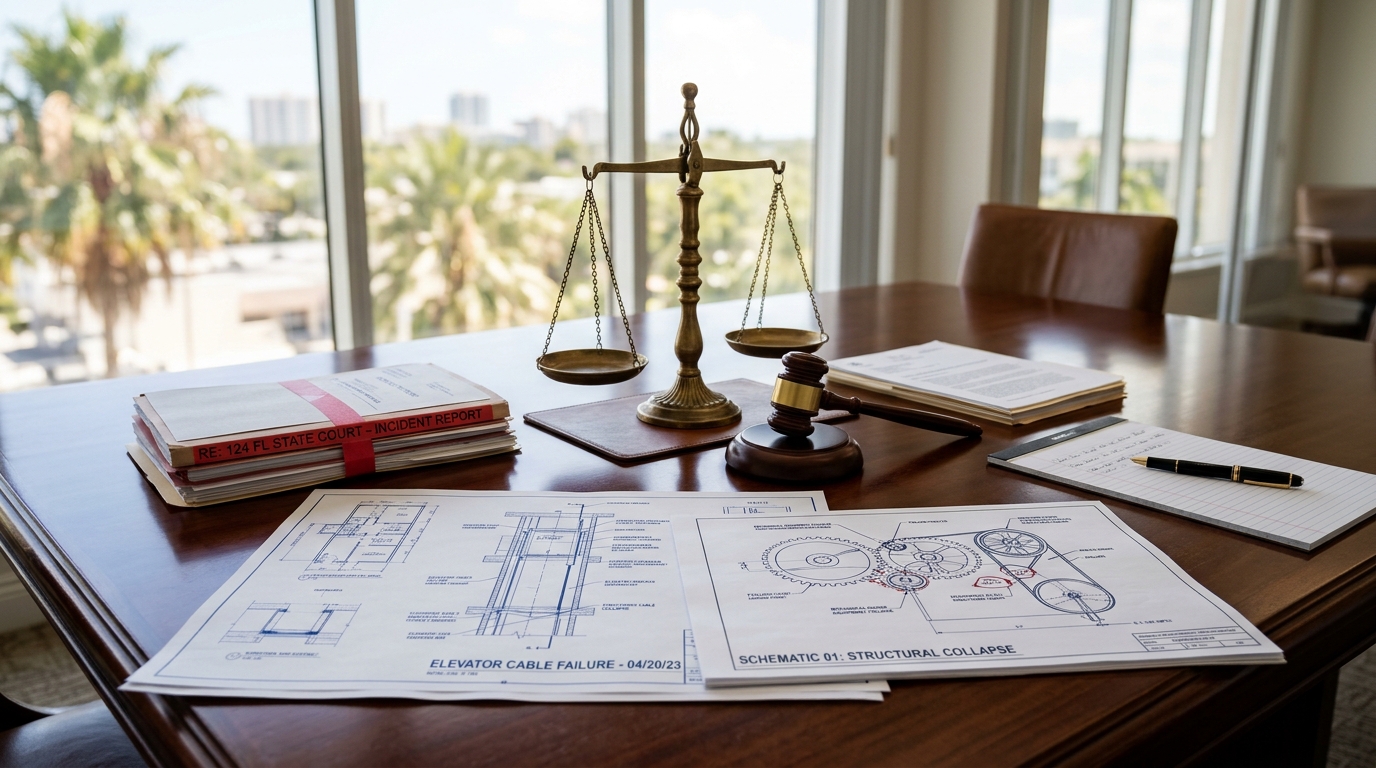
• Elevator and Escalator Malfunctions: An elevator suddenly plunging between floors, free-falling, or doors crushing a passenger without warning often implicates the building owner's and maintenance contractor's exclusive management.
• Falling Fixtures and Building Objects: Large lighting fixtures, ceiling tiles, or structural commercial building components detaching and falling onto shoppers or restaurant patrons.
• Sudden Commercial Mechanical Failures: Commercial truck wheels detaching on the highway (the exact scenario in McDougald v. Perry) due to negligent maintenance of spare tire cradles.
• Retained Surgical Foreign Bodies: Under Florida Statutes § 766.102(3)(b), the discovery of a surgical sponge, clamp, or instrument left inside a patient's body constitutes prima facie evidence of medical negligence.
How insurance companies and defense lawyers defend against res ipsa claims
Defense attorneys and commercial insurers aggressively push back against res ipsa loquitur arguments by attempting to defeat the "exclusive control" element. Common defense strategies include:
• Blaming third-party vendors, manufacturers, or independent maintenance companies.
• Claiming the failure was caused by a sudden, undetectable latent defect that reasonable inspections could not reveal.
• Arguing comparative negligence under Florida Statutes § 768.81, asserting that the injured person misused the equipment or failed to observe open warnings.
Good to Know
Under Florida's modified comparative fault law (F.S. § 768.81), if an injured party is found to be greater than 50% at fault for their injuries, they are completely barred from recovering damages in negligence claims.
Frequently Asked Questions
Res Ipsa Loquitur in Florida Injury Claims: When Negligence Speaks for Itself FAQs
Does res ipsa loquitur guarantee a settlement or trial verdict in Florida?
No. Res ipsa loquitur is a rule of evidence that permits an inference of negligence; the defense can present evidence of proper maintenance and inspection to rebut the inference before the jury.
What is the statute of limitations for personal injury claims in Florida?
Under Florida Statutes § 95.11, the statute of limitations for negligence claims occurring on or after March 24, 2023, is generally two years from the date of the incident.
Does the doctrine apply to slip and fall accidents in grocery stores?
Rarely. Florida Statutes § 768.0755 specifically governs premises liability for transitory foreign substances, requiring plaintiffs to prove actual or constructive notice rather than relying on res ipsa loquitur.
Can res ipsa loquitur apply if multiple parties maintained the equipment?
Yes, Florida courts have recognized that exclusive control can extend to shared or concurrent control between building owners and contracted service companies who manage specialized equipment.
Talk to Pipas Law Group
Have questions after an accident?
The Pipas Law Group team can review the details, explain what may matter, and help you think through your next step.