
You slipped on a wet grocery-store floor and suffered a serious injury. The fall may have been preventable, but under Florida law, proving that a dangerous substance caused the fall is only the beginning.
Florida Statutes § 768.0755 generally requires an injured person who slips on a transitory foreign substance in a business establishment to prove that the business had actual or constructive knowledge of the condition and should have acted to remedy it. Understanding how to prove constructive notice is the cornerstone of any successful Florida slip and fall case.
The legal burden: a spill alone does not establish liability
The rule applies to temporary hazards such as spilled drinks, tracked-in water, or dropped food. A claim needs evidence connecting the hazard to what the business knew - or reasonably should have known - before the fall.
The statute does not eliminate other common-law duties owed by those who possess or control premises, but it places the initial burden of proving notice squarely on the injured claimant.
Key Point
Under § 768.0755, slipping on a spill is not enough by itself. You must prove the business knew about the hazard (actual notice) or should have discovered it through reasonable care (constructive notice).
Actual notice versus constructive notice
Actual notice means the business knew about the hazard: for example, an employee saw the spill, received a warning, or documented it before the incident.
Constructive notice can be established through circumstantial evidence. Section 768.0755 identifies two routes: the hazard existed long enough that reasonable care should have discovered it, or the condition occurred regularly enough to be foreseeable.
A timestamped camera recording can show when a drink spilled and how long it remained. Footprints, cart tracks, drying patterns, cleaning logs, incident reports, and employee testimony may help reconstruct the timeline. Repeated leaks near a freezer or recurring rainwater accumulation at an entrance may support the regularity theory. No single fact automatically proves notice.
Evidence Tip
Footprints, grocery cart tracks, or dried/sticky edges around a puddle serve as critical circumstantial evidence proving a spill was on the floor for an extended period.
Free Consultation
Have questions about your next step?
A short conversation can help you understand what records matter, how insurance may respond, and whether legal help makes sense for your situation.
Four immediate steps before evidence disappears
• Report the fall. Tell a manager, request an incident report, and obtain the report number or contact details. Avoid guessing about the cause.
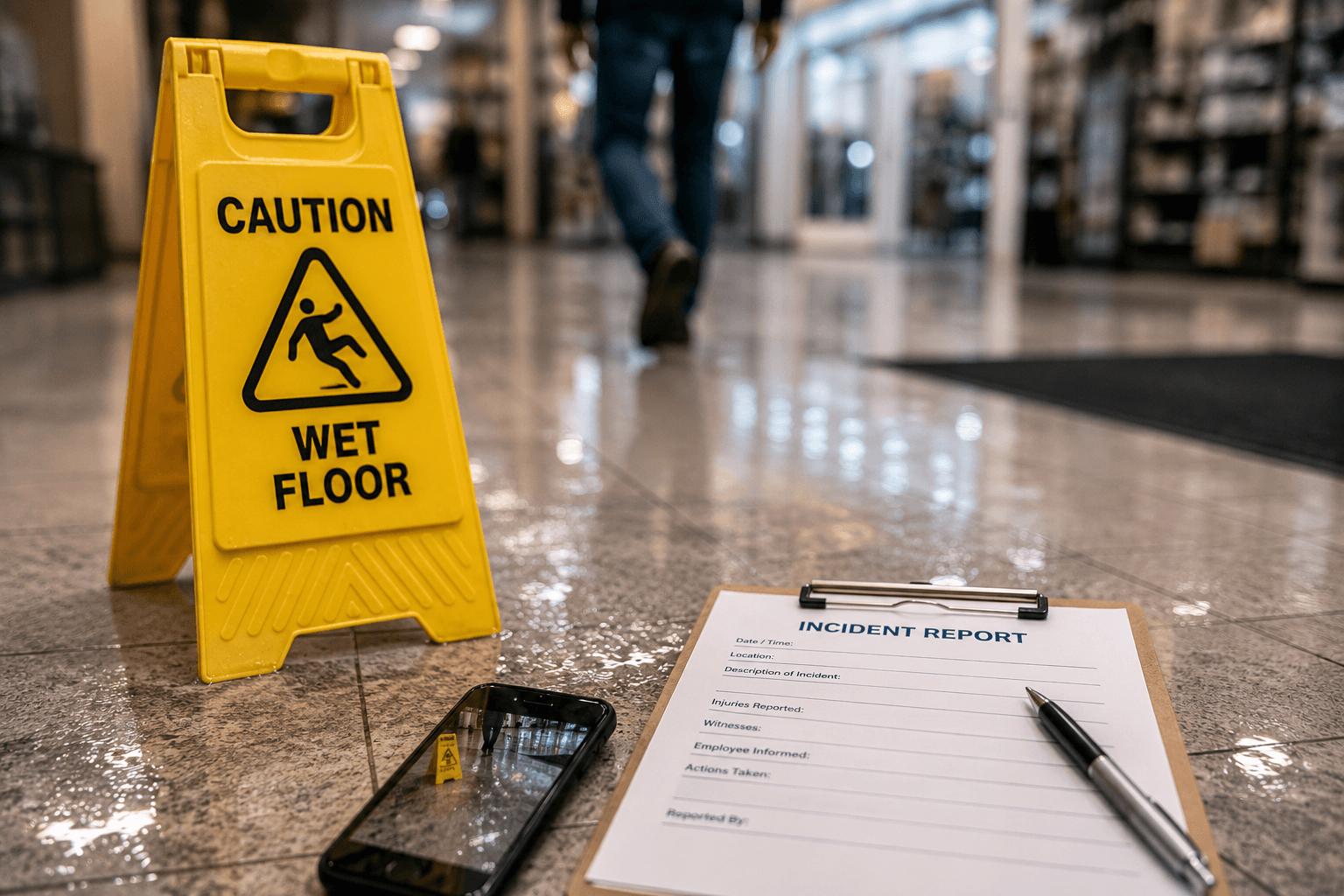
• Document the scene. Photograph the substance, floor, shoes, warning signs, surrounding displays, and any visible injuries before cleanup if it is safe to do so.
• Identify witnesses and cameras. Save names and contact information; ask that surveillance video covering the area and time before the fall be preserved.
• Get medical care and protect records. Describe symptoms accurately, retain receipts and medical instructions, and avoid recorded insurer interviews or broad medical authorizations before understanding their consequences.
Insurance traps that can undermine a valid claim
An adjuster may argue that the business had no time to discover the spill, that the hazard was obvious, or that your shoes or phone caused the fall. An early settlement offer may arrive before doctors know whether an injury will require surgery or long-term treatment.
A request for an unrestricted medical release can expose unrelated health history.
Keep descriptions factual, do not speculate about how long a spill existed, and do not sign a release merely to obtain a quick payment. Florida comparative-fault rules may also affect recovery depending on the facts and applicable law.
How Pipas Law Group investigates commercial property negligence
An effective investigation starts with a preservation request for surveillance footage, inspection and cleaning schedules, employee communications, prior complaints, and incident records.
Counsel can compare timestamps, interview witnesses, examine the hazard location, and evaluate whether the evidence supports actual notice, a sufficient timeline, or a recurring condition.
If you were injured in a slip and fall in St. Petersburg, Tampa Bay, or elsewhere in Florida, contact Pipas Law Group for a free consultation. Early legal review can help identify the evidence that matters before it is overwritten or lost.
Frequently Asked Questions
Proving Negligence in a Florida Slip and Fall: What Is “Constructive Notice”? FAQs
What is constructive notice in a Florida premises liability case?
Constructive notice means proving through circumstantial evidence (such as surveillance video, dirty footprints, or cleaning logs) that a hazard existed on the floor long enough that store employees should have discovered and cleaned it up.
What is a transitory foreign substance under Florida law?
A transitory foreign substance is any temporary, misplaced object or liquid that does not belong on the floor, such as spilled water, soda, dropped grapes, melting ice, or cooking grease.
How quickly can a business erase security footage of my fall?
Many businesses overwrite surveillance recordings every 14 to 30 days. Sending a formal spoliation letter immediately after the fall is essential to preserve video evidence.
Can I recover damages if there was no warning cone or sign?
Yes. In fact, the absence of caution cones or warning signs when a hazard was present supports your claim that the business failed to exercise reasonable care.
Talk to Pipas Law Group
Have questions after an accident?
The Pipas Law Group team can review the details, explain what may matter, and help you think through your next step.